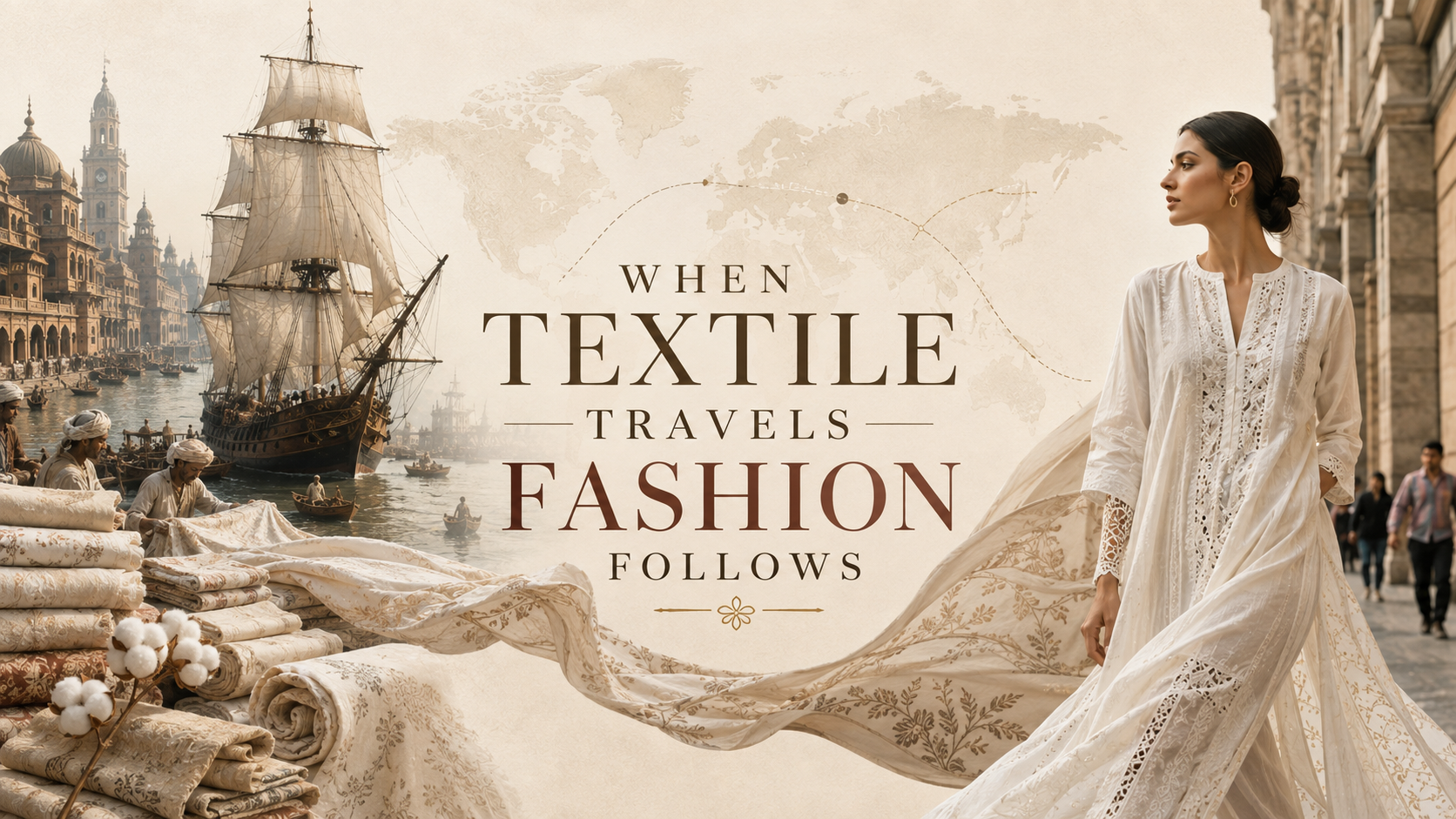
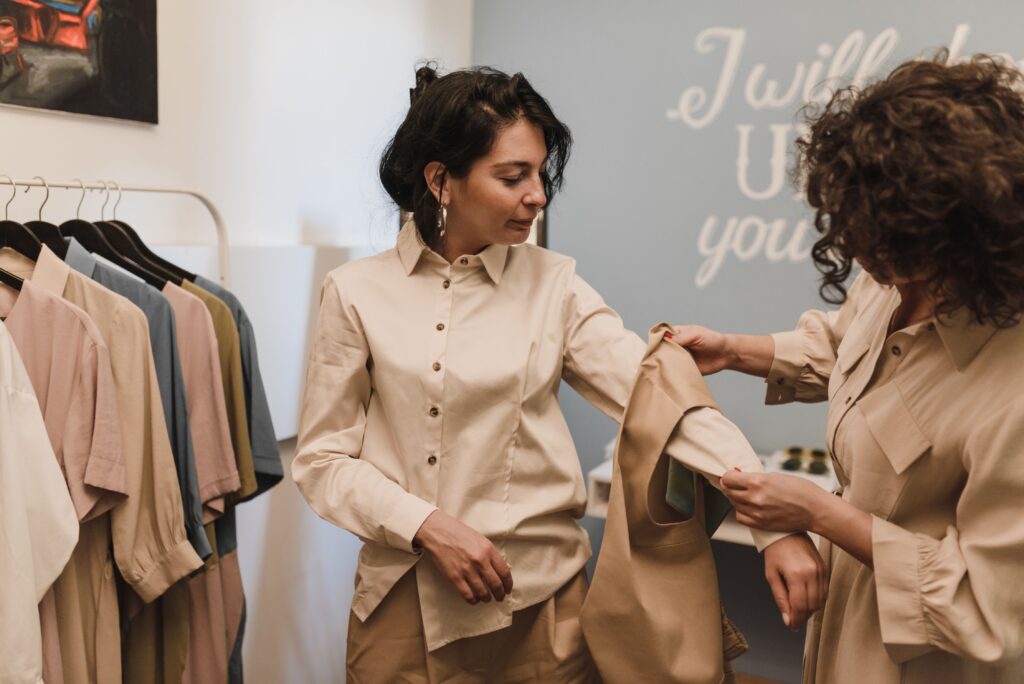
How trade carried fabrics, craftsmanship, and timeless design across cultures.
Fashion is often described as a reflection of culture, but it is equally a reflection of movement.
Long before social media, fashion magazines, or international fashion weeks, ideas travelled across continents through merchants, explorers, and trade routes. Fabrics crossed oceans, artisans shared techniques, and garments evolved as different cultures encountered one another. Every textile carried more than thread. It carried stories, craftsmanship, and inspiration.
Today, when we admire a beautifully embroidered dress, it’s easy to see only the finished garment. What we often overlook is the centuries of exchange that shaped the way it looks.
Fashion Has Always Travelled
The history of fashion is deeply connected to the history of trade. Silk travelled from China to Europe through the Silk Road. Indian cotton and muslin became highly sought after across Europe for their softness and breathability. Fine textiles were never simply traded as commodities. They influenced the way people dressed, the fabrics designers preferred, and even the silhouettes that became fashionable.
Trade did more than move products. It moved ideas, sometimes unchanged, and sometimes blended with local traditions to create something entirely new.
A Fascinating Similarity
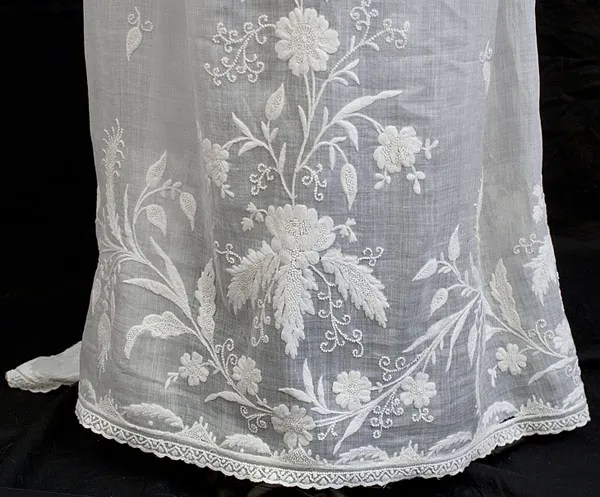
While researching historical embroidery traditions, one comparison immediately caught my attention: Victorian Whitework embroidery and Lucknow’s Chikankari.
At first glance, they belong to different worlds. Victorian Whitework became popular in nineteenth century Europe, while Chikankari has its roots in India and flourished during the Mughal period. Yet visually, the two traditions share some remarkably similar characteristics: white thread embroidered on white fabric, delicate floral motifs inspired by nature, flowing botanical patterns, and lightweight fabrics such as cotton and muslin. In both, texture takes precedence over colour, favouring soft elegance over bold decoration.
One particularly interesting parallel is the use of subtle, shadow-like effects. In Chikankari, stitches such as Bakhiya, often called shadow work, create delicate depth by working from the reverse side of the fabric. Victorian Whitework relied on a similar principle, leaning on texture and tonal contrast rather than colour, so that garments felt refined through craftsmanship rather than ornamentation.
These similarities don’t necessarily mean one tradition directly influenced the other. Each developed within its own cultural and historical context. But placing them side by side reveals something worth noticing: how different cultures, working independently, can arrive at strikingly similar expressions of beauty.
When Trade Moves More Than Fabric
History shows us that textiles travelled extensively across continents. European demand for Indian cotton and muslin grew significantly because these fabrics offered a lightness and comfort that was difficult to replicate elsewhere at the time. As fabrics moved through international trade, they introduced designers, merchants, and consumers to new materials and new possibilities.
Trade doesn’t simply transport products. It introduces people to unfamiliar craftsmanship, changes preferences, and encourages experimentation. Over time, these exchanges shape fashion itself.
Whether every shared design detail can be traced to direct influence is a question historians continue to explore. What’s undeniable is that global textile trade created space for cultures to observe, appreciate, and reinterpret one another’s craftsmanship.
Why These Similarities Still Feel Relevant
Perhaps this is why Chikankari continues to feel so natural on contemporary Western silhouettes.
As a designer, I’m often drawn to details like pintucks, smocking, soft gathers, ruffles, and occasionally pearl embellishments when creating garments with Chikankari. Interestingly, many of these same elements were widely appreciated during the Victorian era. It makes me wonder whether certain design languages simply transcend geography and time. Delicate embroidery, airy cotton fabrics, soft feminine silhouettes, elegant texture: these qualities continue to resonate because they create a feeling of timeless sophistication, regardless of where they originated.
Looking Beyond Fashion
The next time you see an embroidered white dress, it may be worth asking a different question. Instead of wondering where it was made, consider how many journeys, cultures, and generations of craftsmanship helped shape its aesthetic.
Fashion is rarely confined by borders. Textiles travel. Ideas travel. Craftsmanship travels.
And sometimes, centuries later, those journeys quietly reveal themselves in the remarkable similarities between traditions that once seemed worlds apart.
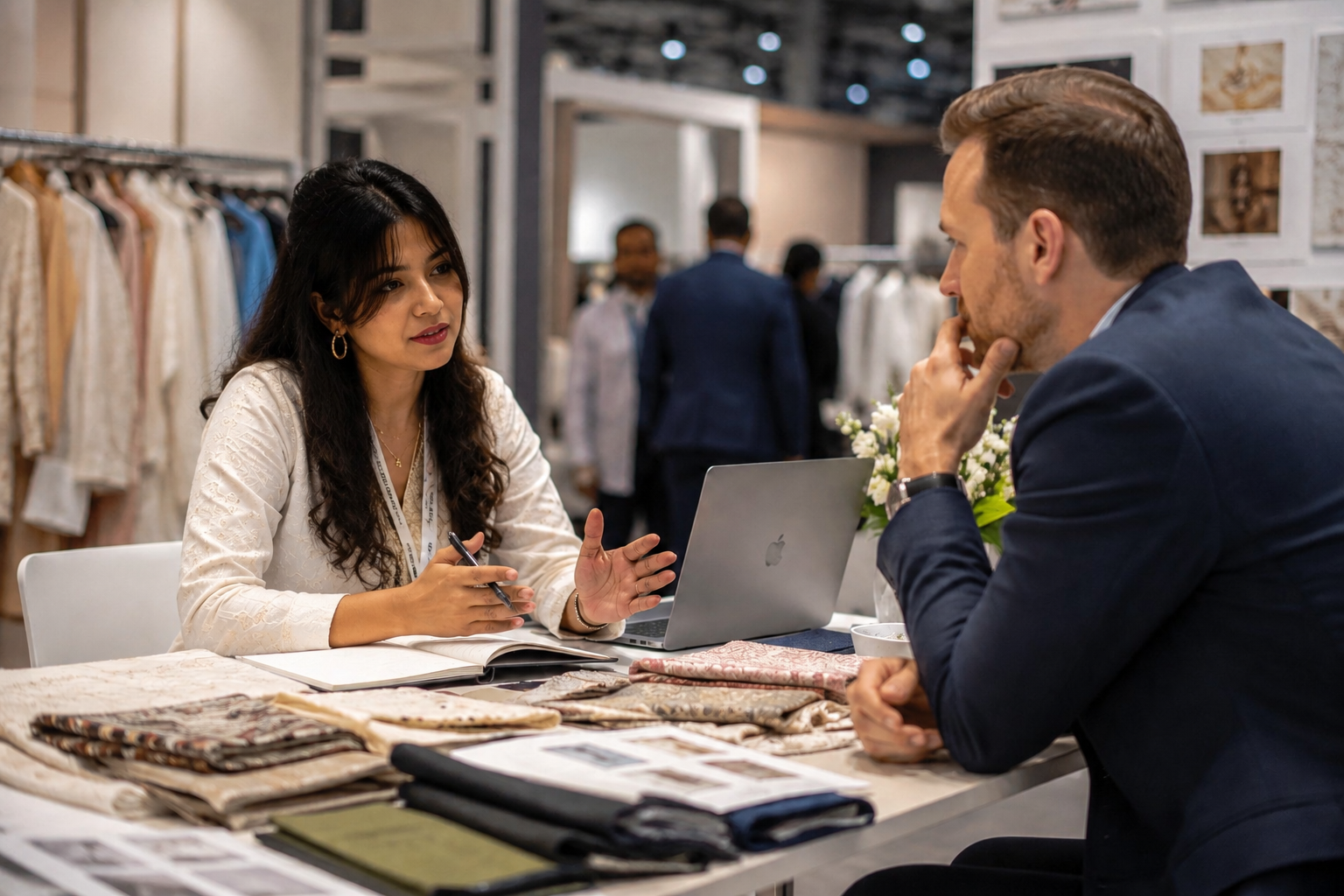
For a first-time exporter, attending an international B2B meeting can feel like a major opportunity. You prepare your samples, carry your catalogue, exchange business cards, and hope to meet buyers interested in your products.
But a B2B meeting is not simply about putting your products in front of international buyers. It’s about understanding who you are meeting, what they are looking for, whether your business is relevant to their market, and how clearly you can communicate your capabilities.
This is something I learned gradually through my own experience of attending exhibitions and international B2B meetings. Early on, I believed that having good products and samples would be enough to generate interest. With time, I realised that product quality is only one part of the conversation.
A buyer may like your product, but they also want to understand your MOQ, production capacity, lead time, pricing, manufacturing structure, customization capabilities, quality-control processes, sampling terms and, more importantly, whether your business can actually meet their requirements.
So if you’re preparing for your first international B2B meeting, here’s what I wish someone had told me before I walked into the room.
1. Understand How the Event Actually Works
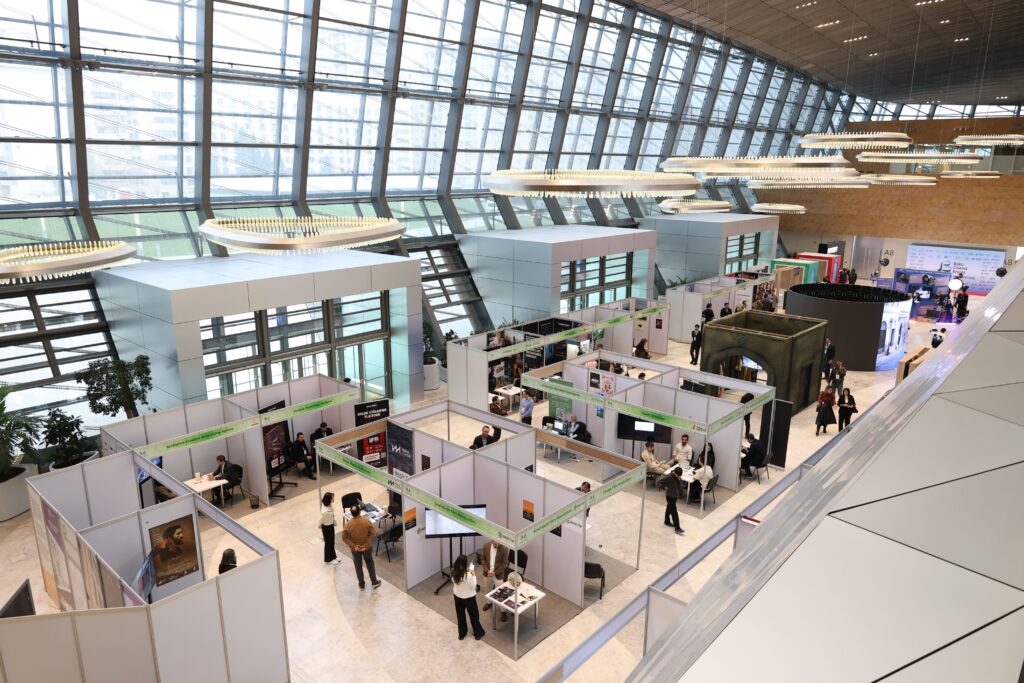
Before attending an exhibition, find out how international buyers will participate. Some events run scheduled B2B meetings, hosted-buyer programmes, or sector-specific halls; others may have a more open-floor format.
Ask the organisers whether buyers are attending, whether meetings are pre-scheduled or open, whether exhibitors need to register separately, and where the meetings will actually take place.
Early in my export journey, I learned this the hard way at one exhibition, where the international B2B meetings ran in a separate space from the hall I was exhibiting in. It taught me to always understand an event’s structure in advance so I can plan my time, products, and presentation accordingly.
2. Know Your Business Before You Enter the Room
You don’t need to know everything about international trade before your first B2B meeting. But you should know your own business, your MOQ, production capacity, lead time, product specifications, sampling terms, pricing structure, customization capabilities, payment terms, and quality-control processes.
If you outsource manufacturing, be transparent about it and understand the capabilities of the manufacturers working with you.
There’s no need to make your business appear larger than it is. Clear, truthful answers build far more confidence than exaggerated claims that fall apart under detailed questions.
During one of my early meetings, I was asked about a quality-control process I hadn’t anticipated, and the question caught me off guard. It taught me that being prepared doesn’t mean having an answer to everything it means knowing your current capabilities well enough to answer honestly.
A simple “We don’t currently have that process in place, let me understand your exact requirement and come back to you with a clear answer” is far stronger than a bluff or a promise you can’t keep.
3. Listen Before You Pitch
One of the easiest mistakes to make in a B2B meeting is launching straight into a full presentation of everything you sell.
Before opening your catalogue, ask questions instead.
What is the buyer looking for? Which market do they sell in? Are they a retailer, wholesaler, importer, distributor, or sourcing company? What price segment and quantities do they typically work with?
The goal isn’t just to collect information. It’s to understand whether your product is genuinely relevant to the person across the table.
Once you know that, keep your own presentation crisp: who you are, what you make, what makes it different, and why it might matter to this buyer. Then let the conversation develop naturally.
A good B2B meeting is an exchange, not a rehearsed monologue.
4. Know Your USP and Say It Clearly
Ask yourself before every meeting: why should this buyer remember my business after meeting several others?
Your USP might be a specialised product category, hand craftsmanship, customization ability, a particular technique, flexible product development, or deep knowledge of a specific market segment.
Whatever it is, be able to explain it clearly and specifically.
Generic claims like “best quality” or “best price” apply to almost every supplier and rarely stand out.
Your USP should tell the buyer something meaningful about what makes working with your business different.
5. Be Open to Customization, but Know Your Limits
Customization can open real opportunities. A buyer may like your product but need changes in fabric, colour, sizing, construction, or detailing to suit their market.
Being willing to explore those requirements is valuable.
But saying yes to everything isn’t.
It’s tempting, especially early on, to answer every “Can you do this?” with yes. The risk comes later if the commitment can’t actually be met.
The better habit is to understand the requirement fully, evaluate your technical and production capabilities honestly, and then answer.
Being flexible can help you win business. Making promises you cannot fulfil can damage the trust you are trying to build.
6. Know Your Price Before Someone Challenges It
Price negotiations are a normal part of business, but I’ve learned that not every price comparison is a fair one. Two products can sit in the same broad category and still have completely different cost structures, in apparel, fabric, construction, embroidery, craftsmanship, finishing, and quality requirements all shape the final number.
Before I walk into any meeting now, I make sure I know my product cost, my minimum viable price, and exactly which elements can flex versus which can’t without changing the product itself.
So when a buyer asks for a lower price, I’ve stopped treating it as a yes-or-no question. Instead, I ask: “What would need to change in the product, quantity, or terms to make that price work?” It keeps the conversation collaborative, and it usually reveals whether we’re actually comparing the same thing in the first place.
7. Decide Your Sample Policy in Advance
Samples can be an expensive part of export business, especially for labour-intensive or high-value products.
Early on, I gave away several garment samples hoping they would lead to orders in new markets. They didn’t, and that experience changed how I think about sampling.
The economics of samples vary significantly between industries. A low-cost consumable sample and a fully constructed, hand-embroidered garment represent very different costs, so the right sample policy will depend on your product and business model.
Before your next meeting, decide: will you offer free samples, charge the full cost, offer an introductory price, or adjust the cost against a future bulk order? Who covers shipping?
There is no single policy that works for every exporter.
What matters is having one.
A clear sample policy means you are not making an expensive commercial decision on the spot simply because someone is standing in front of you asking for a product.
8. Progress Matters More Than Enthusiasm
A compliment on your product doesn’t guarantee a quotation request.
A quotation request doesn’t guarantee a sample request.
A sample request doesn’t guarantee an order.
That’s not a reason for suspicion. It’s a reason to pay attention to whether the commercial relationship is actually progressing.
Are the buyer’s requirements becoming more specific? Are quantities being discussed? Are they responding to quotations? Are product specifications or commercial terms being evaluated? Is there a clear next step?
Enthusiasm feels good in the moment.
Progress is what actually moves a business relationship forward.
9. Understand Who You’re Talking To
The person across the table may be an owner, buyer, merchandiser, purchasing manager, trader, or sourcing professional and not everyone has the authority to make a commitment on the spot.
They may need to compare suppliers, review samples, evaluate prices, discuss your products internally, or consult other decision-makers before moving forward.
That is a normal part of how sourcing decisions can be made.
It also means your goal in a first meeting isn’t necessarily to close an order.
Sometimes, the objective is to establish genuine commercial compatibility and give the conversation a reason to continue.
10. Follow Up With Purpose
After the meeting, ask how the buyer prefers to be contacted, some may prefer WhatsApp, while others prefer email and respect that choice.
Then follow up with relevance, not repetition.
Research the company: its products, target market, customer segment, and price positioning.
Refer back to something discussed during the meeting. Share products that are actually relevant to the buyer rather than repeatedly sending your full catalogue.
A thoughtful follow-up shows one simple but important thing:
You were listening.
11. Carry More Than Samples and Business Cards
Depending on your industry, consider bringing:
Carefully selected physical samples
A physical and easily accessible digital catalogue
Business cards
A QR code linking to your website or digital catalogue
A notebook for recording buyer requirements
Clear information about your MOQ, capacity, and lead time
Relevant process, production, or craftsmanship videos
If you can genuinely wear or use your own product, consider becoming part of your own presentation. As a designer, wearing my own pieces has often helped me introduce my work naturally.
But the most important thing you carry into any meeting is a clear understanding of your own business.
What Actually Makes a Successful B2B Meeting?
A successful B2B meeting doesn’t always end with a purchase order and for a first-time exporter, that can be difficult to accept after investing in exhibiting, samples, and travel.
But international business relationships may take more than one interaction to develop.
A good conversation can help you understand what buyers are looking for, how your product is perceived, what questions your business needs to answer, and whether there is real potential for collaboration.
If I could offer one piece of advice for a first international B2B meeting, it would be this:
Know your product. Know your business. Ask questions. Listen carefully. Communicate clearly. And never promise what you can’t deliver.
Because the purpose of a B2B meeting isn’t simply to show what you sell.
It’s to discover whether what you can offer and what the buyer needs can become a real business relationship.
And sometimes, the most valuable thing you walk away with isn’t an order.
It’s a clearer sense of what your business needs to do next.
With Bharat Tex 2026 approaching, international buyers have an opportunity to look beyond simply sourcing products at a lower cost. India is a place to source products with craftsmanship, heritage, and a story.
For international apparel buyers visiting India, sourcing can initially feel overwhelming. The country is vast, its textile industry is diverse, and the choices range from large-scale factories to small manufacturers, exporters, artisan clusters, and businesses specializing in traditional crafts.
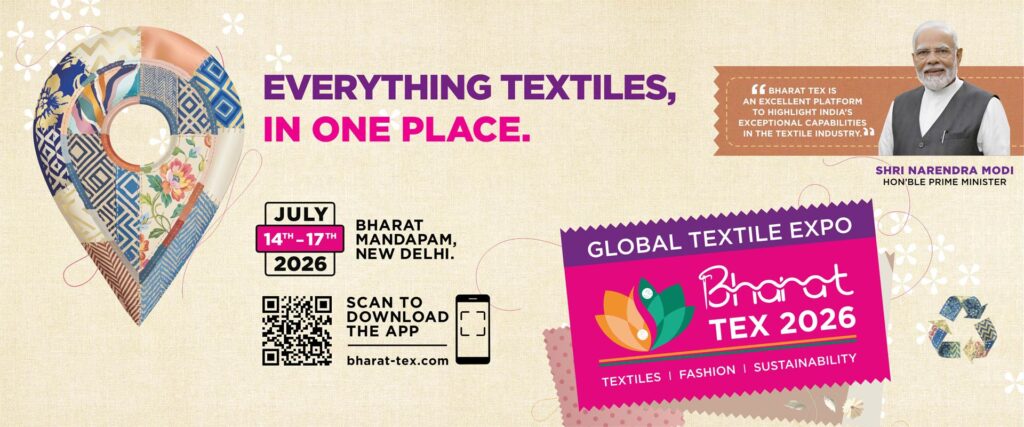
With Bharat Tex 2026 bringing the global textile industry together in New Delhi, international buyers have an opportunity to discover much more than suppliers and products. They have an opportunity to understand what makes sourcing from India different.
Look Beyond the Lowest Price
Price will naturally remain an important part of every sourcing decision. Buyers have margins to protect, markets to compete in, and consumers with different price expectations.
However, the cheapest quotation is not always the most economical decision in the long run. A difference in price can reflect a difference in fabric quality, construction, finishing, embroidery, embellishment, quality control, or production practices. Two garments may look similar in a photograph and still be significantly different when examined closely.
How does the fabric feel? How neatly are the seams finished? How consistent is the embroidery? How securely are embellishments attached? How does the garment perform after washing?
These details eventually affect not only the price of the garment, but also the experience of the final consumer. For this reason, buyers should compare quality with price rather than price alone.
Behind Every Price Is a Supply Chain of People
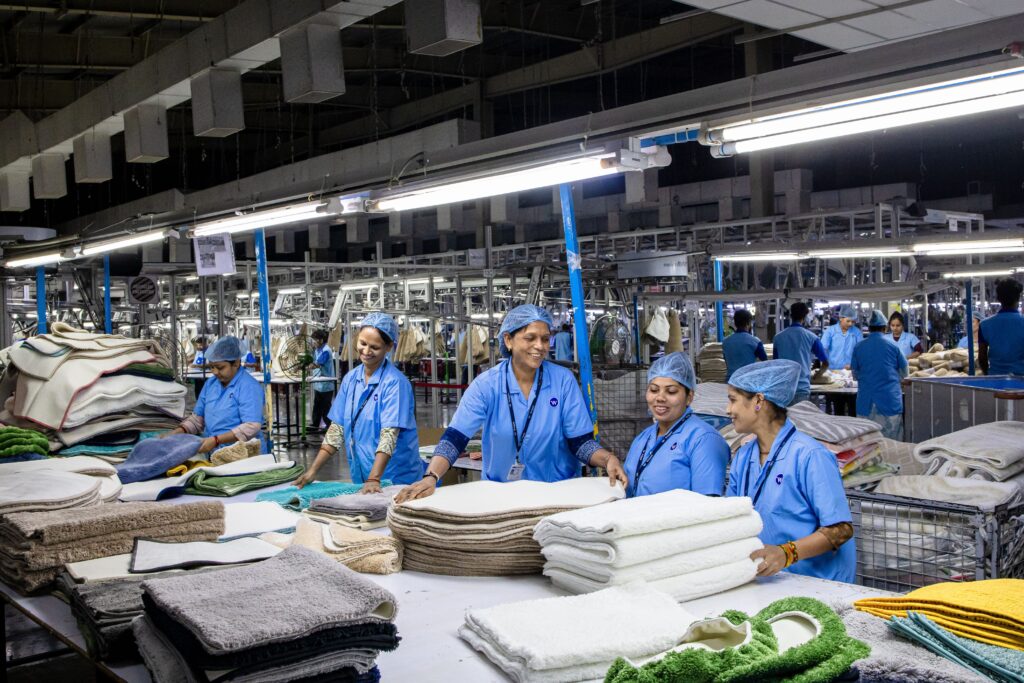
There is another reality of apparel sourcing that is rarely discussed enough. Behind every garment are people. Tailors, embroiderers, artisans, finishers, pattern makers, production workers.
When sourcing decisions are driven exclusively by obtaining the lowest possible price, the pressure eventually travels down the supply chain. And very often, the people at the lowest levels of that chain have the least ability to absorb it.
Responsible sourcing does not mean buyers should ignore commercial realities or accept unreasonable prices. It means understanding that a sustainable sourcing relationship should create value throughout the supply chain for the buyer, the supplier, and the people whose skills ultimately create the product.
Source a Product With a Story
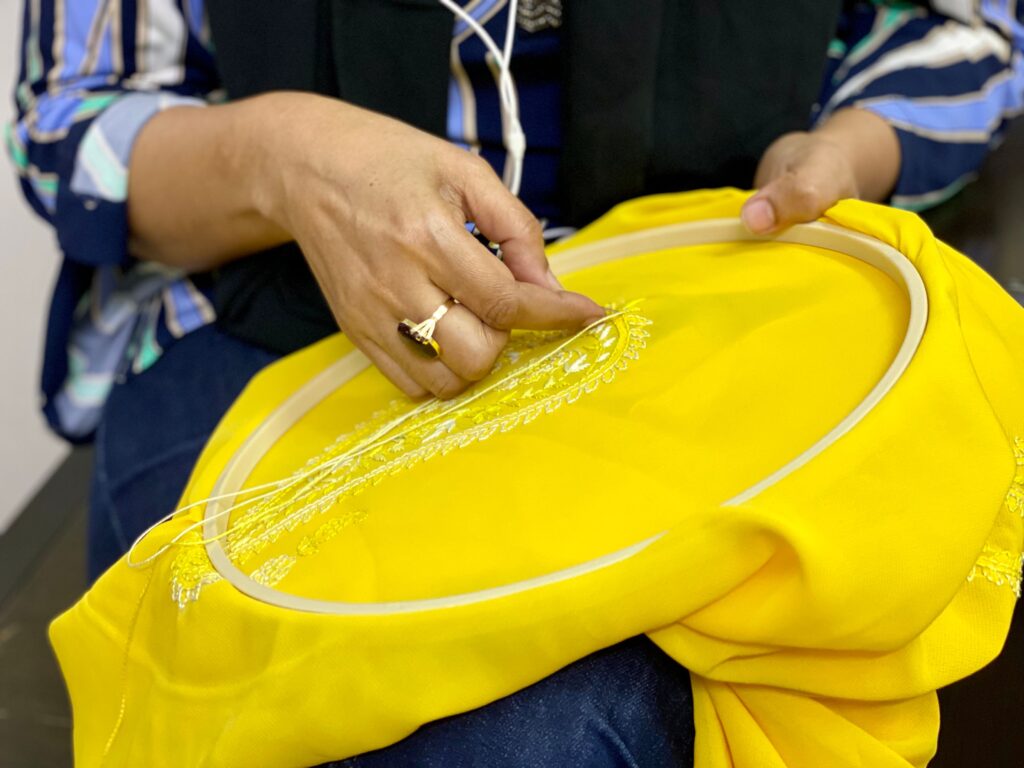
One of India’s greatest strengths as a sourcing destination is its diversity. A buyer can find modern manufacturing capabilities while also discovering textile traditions and craftsmanship developed across generations. Different regions of India are known for different fabrics, embroideries, weaving techniques, printing traditions, and surface ornamentation.
For international brands, this creates an interesting opportunity: you are not simply sourcing another garment. You can source a product whose craftsmanship, origin, technique, and people give you a genuine story to share with your customers. In increasingly competitive markets, a meaningful product story can become part of the product’s value.
The important distinction, however, is authenticity. A story should come from the actual product and the people involved in creating it not be manufactured later as a marketing strategy.
Start Small When Working With a New Supplier
Finding an interesting supplier at an exhibition is only the beginning. A good catalogue, an impressive booth, or a productive conversation cannot tell you everything about how a company will perform once production begins.
When working with a supplier for the first time, starting with a smaller order can reduce risk for both parties. A trial order allows a buyer to evaluate product quality and consistency, communication, sampling and development capabilities, adherence to specifications, production timelines, packaging, and problem solving ability.
Once trust and working compatibility have been established, order quantities can grow. For smaller and emerging brands in particular, suppliers willing to work with reasonable initial MOQs can provide the flexibility needed to test products before committing to larger quantities.
Ask What the Supplier Is Actually Good At
India’s textile and apparel industry is enormous. That does not mean every supplier is equally good at producing every type of product. One supplier may specialize in high-volume basic garments, another may be stronger in small-batch production. Some businesses specialize in specific fabrics, while others have expertise in hand embroidery, embellishment, traditional crafts, or complex product development.
Instead of only asking “What products can you manufacture?” consider asking “What type of product are you best at manufacturing?” The answer can tell you far more about whether the supplier is genuinely suitable for your business.
Evaluate the System Behind the Sample
India’s textile and apparel industry is enormous, and not every supplier is equally good at every type of product. One may specialize in high-volume basics, another in small-batch work, specific fabrics, hand embroidery, or complex product development. Instead of only asking “What products can you manufacture?” consider asking “What type of product are you best at manufacturing?” The answer tells you far more about fit.
A beautiful sample is important, but it only tells you what a supplier can do once. The real test is whether they can maintain that same quality across a full production run and for a first-time buyer, the most practical way to find out is not a factory audit before ordering, but a small trial order itself.
At the booth, it still helps to ask the right questions: What is their realistic monthly capacity? Can they work from a technical spec sheet, or develop from a reference design? How are changes and approvals documented, and what happens when a production problem occurs? Their answers won’t confirm anything on their own, but they will tell you how clearly a supplier thinks about their own process and that’s often the best signal you’ll get before placing an order.
If a factory visit ever makes sense, it usually comes later once a PO is placed and the first batch is in production, not before. The strongest supplier is not necessarily the one who promises to do everything. Often, it is the one who communicates clearly about what they can do, what they cannot, and how they intend to meet your requirements and this is also where price comparisons should account for what’s actually behind the number, not just the figure itself.
Communication Matters More Than Many Buyers Expect
A successful sourcing relationship does not end when the purchase order is placed. In many cases, that is where the real work begins. Product development often requires questions, changes, approvals, clarifications, and problem-solving, and clear communication between buyers and suppliers can prevent expensive mistakes.
When meeting potential suppliers, pay attention to whether they ask questions about your requirements. A supplier who wants to understand your target market, quality expectations, quantities, and price positioning may ultimately be more valuable than one who simply agrees to everything immediately.
Use Bharat Tex to Build Relationships, Not Just Collect Business Cards
It is easy to leave a large trade event with dozens or hundreds of catalogues, brochures, and business cards. The more important question is: how many meaningful sourcing conversations did you have?
Before leaving a supplier’s booth, make notes. What interested you? Which products did you discuss? Did you request samples? Was there a particular capability relevant to your business? What is the next step?
After the event, follow up with the suppliers who genuinely match your sourcing requirements. A smaller number of well-evaluated potential partners is often more valuable than a large collection of contacts with no clear next action.
A Quick Checklist Before You Walk the Floor
A few questions worth carrying into every supplier conversation at Bharat Tex 2026:
What is this supplier genuinely best at, not just what can they make?
What exactly am I getting for this price, compared to the next quotation?
Can they walk me through their quality control process, not just show me a sample?
What is a realistic trial order size to test this relationship first?
Are they asking me questions about my market, or just agreeing to everything?
What’s the actual story behind this product and can they show me, not just tell me?
What’s my next step with this supplier, and when will I follow up?
Final Thoughts
For international buyers visiting India, Bharat Tex 2026 is an opportunity to experience the scale and diversity of the Indian textile and apparel industry. But the most successful sourcing decisions are unlikely to come from searching for the cheapest product or collecting the largest number of supplier contacts.
Look for quality that matches the price. Understand the capabilities behind the product. Start with manageable quantities when developing new supplier relationships. Ask questions. Pay attention to communication. And look beyond the garment itself.
Because one of India’s greatest strengths is not simply its ability to manufacture products. It is its ability to create products with craftsmanship, human skill, heritage, and stories that can travel from the hands of the people who make them to consumers around the world.