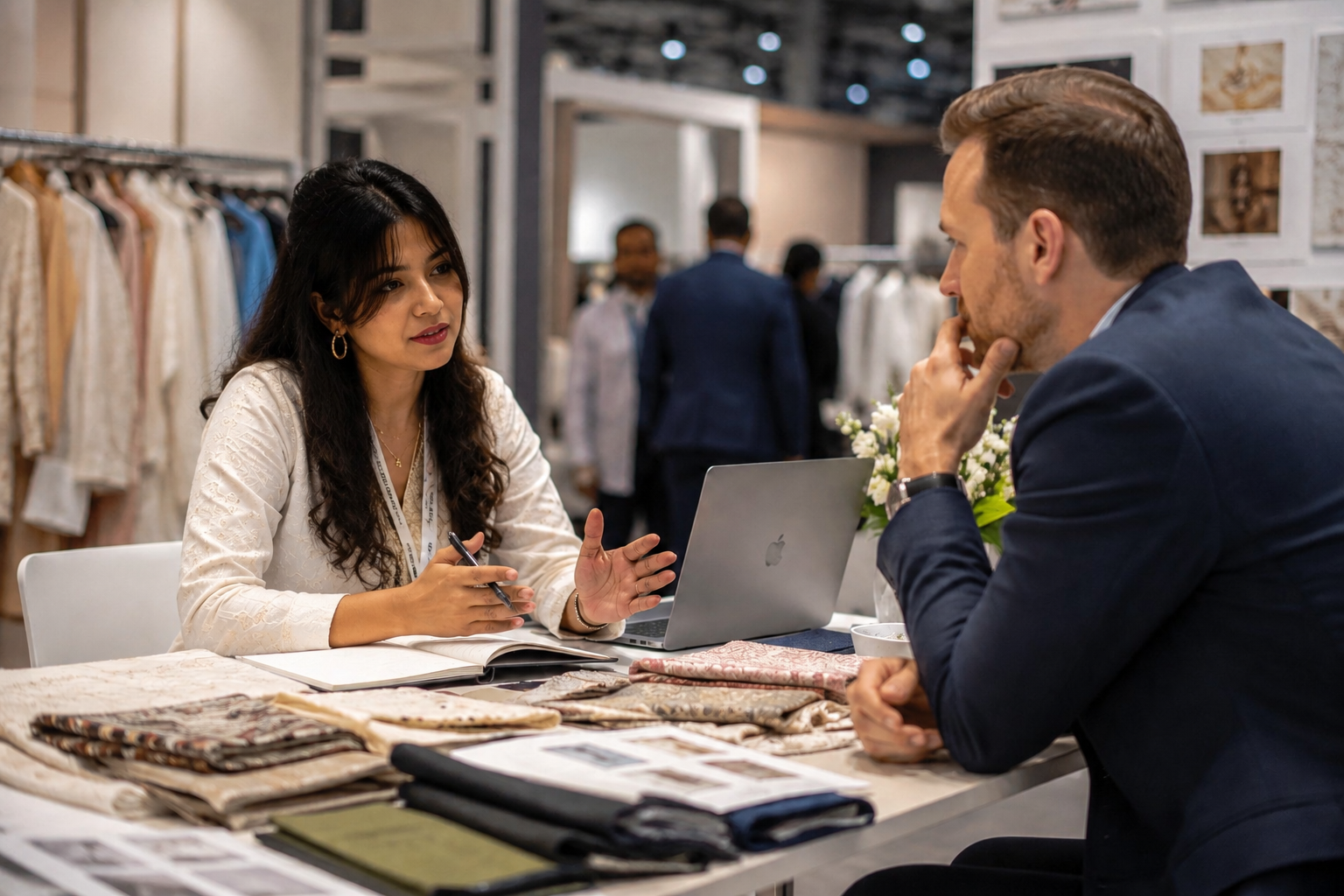
For a first-time exporter, attending an international B2B meeting can feel like a major opportunity. You prepare your samples, carry your catalogue, exchange business cards, and hope to meet buyers interested in your products.
But a B2B meeting is not simply about putting your products in front of international buyers. It’s about understanding who you are meeting, what they are looking for, whether your business is relevant to their market, and how clearly you can communicate your capabilities.
This is something I learned gradually through my own experience of attending exhibitions and international B2B meetings. Early on, I believed that having good products and samples would be enough to generate interest. With time, I realised that product quality is only one part of the conversation.
A buyer may like your product, but they also want to understand your MOQ, production capacity, lead time, pricing, manufacturing structure, customization capabilities, quality-control processes, sampling terms and, more importantly, whether your business can actually meet their requirements.
So if you’re preparing for your first international B2B meeting, here’s what I wish someone had told me before I walked into the room.
1. Understand How the Event Actually Works
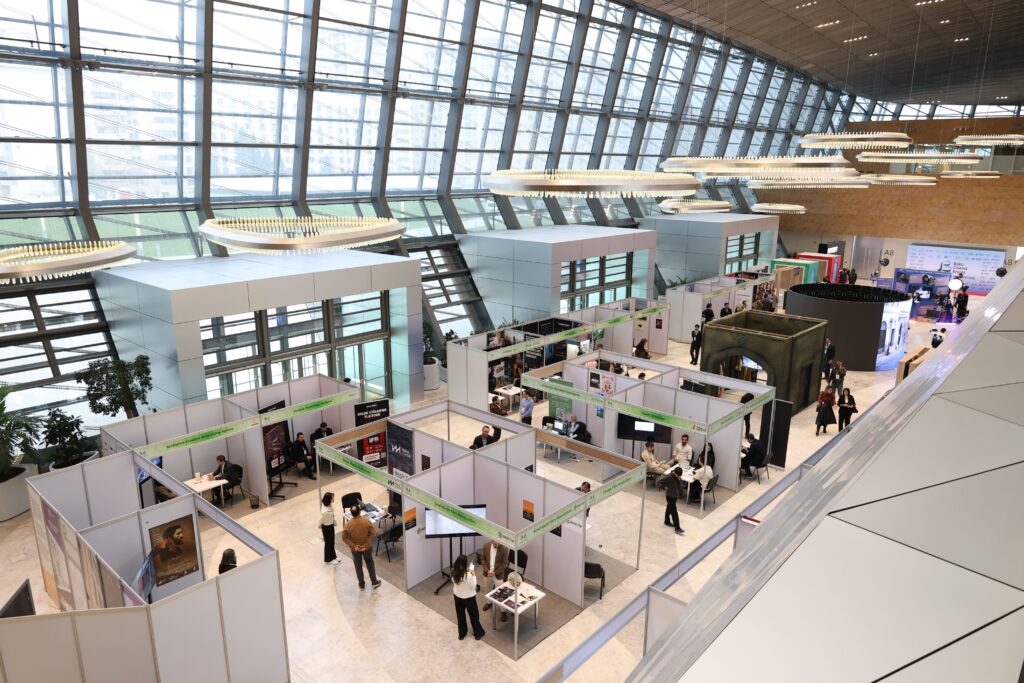
Before attending an exhibition, find out how international buyers will participate. Some events run scheduled B2B meetings, hosted-buyer programmes, or sector-specific halls; others may have a more open-floor format.
Ask the organisers whether buyers are attending, whether meetings are pre-scheduled or open, whether exhibitors need to register separately, and where the meetings will actually take place.
Early in my export journey, I learned this the hard way at one exhibition, where the international B2B meetings ran in a separate space from the hall I was exhibiting in. It taught me to always understand an event’s structure in advance so I can plan my time, products, and presentation accordingly.
2. Know Your Business Before You Enter the Room
You don’t need to know everything about international trade before your first B2B meeting. But you should know your own business, your MOQ, production capacity, lead time, product specifications, sampling terms, pricing structure, customization capabilities, payment terms, and quality-control processes.
If you outsource manufacturing, be transparent about it and understand the capabilities of the manufacturers working with you.
There’s no need to make your business appear larger than it is. Clear, truthful answers build far more confidence than exaggerated claims that fall apart under detailed questions.
During one of my early meetings, I was asked about a quality-control process I hadn’t anticipated, and the question caught me off guard. It taught me that being prepared doesn’t mean having an answer to everything it means knowing your current capabilities well enough to answer honestly.
A simple “We don’t currently have that process in place, let me understand your exact requirement and come back to you with a clear answer” is far stronger than a bluff or a promise you can’t keep.
3. Listen Before You Pitch
One of the easiest mistakes to make in a B2B meeting is launching straight into a full presentation of everything you sell.
Before opening your catalogue, ask questions instead.
What is the buyer looking for? Which market do they sell in? Are they a retailer, wholesaler, importer, distributor, or sourcing company? What price segment and quantities do they typically work with?
The goal isn’t just to collect information. It’s to understand whether your product is genuinely relevant to the person across the table.
Once you know that, keep your own presentation crisp: who you are, what you make, what makes it different, and why it might matter to this buyer. Then let the conversation develop naturally.
A good B2B meeting is an exchange, not a rehearsed monologue.
4. Know Your USP and Say It Clearly
Ask yourself before every meeting: why should this buyer remember my business after meeting several others?
Your USP might be a specialised product category, hand craftsmanship, customization ability, a particular technique, flexible product development, or deep knowledge of a specific market segment.
Whatever it is, be able to explain it clearly and specifically.
Generic claims like “best quality” or “best price” apply to almost every supplier and rarely stand out.
Your USP should tell the buyer something meaningful about what makes working with your business different.
5. Be Open to Customization, but Know Your Limits
Customization can open real opportunities. A buyer may like your product but need changes in fabric, colour, sizing, construction, or detailing to suit their market.
Being willing to explore those requirements is valuable.
But saying yes to everything isn’t.
It’s tempting, especially early on, to answer every “Can you do this?” with yes. The risk comes later if the commitment can’t actually be met.
The better habit is to understand the requirement fully, evaluate your technical and production capabilities honestly, and then answer.
Being flexible can help you win business. Making promises you cannot fulfil can damage the trust you are trying to build.
6. Know Your Price Before Someone Challenges It
Price negotiations are a normal part of business, but I’ve learned that not every price comparison is a fair one. Two products can sit in the same broad category and still have completely different cost structures, in apparel, fabric, construction, embroidery, craftsmanship, finishing, and quality requirements all shape the final number.
Before I walk into any meeting now, I make sure I know my product cost, my minimum viable price, and exactly which elements can flex versus which can’t without changing the product itself.
So when a buyer asks for a lower price, I’ve stopped treating it as a yes-or-no question. Instead, I ask: “What would need to change in the product, quantity, or terms to make that price work?” It keeps the conversation collaborative, and it usually reveals whether we’re actually comparing the same thing in the first place.
7. Decide Your Sample Policy in Advance
Samples can be an expensive part of export business, especially for labour-intensive or high-value products.
Early on, I gave away several garment samples hoping they would lead to orders in new markets. They didn’t, and that experience changed how I think about sampling.
The economics of samples vary significantly between industries. A low-cost consumable sample and a fully constructed, hand-embroidered garment represent very different costs, so the right sample policy will depend on your product and business model.
Before your next meeting, decide: will you offer free samples, charge the full cost, offer an introductory price, or adjust the cost against a future bulk order? Who covers shipping?
There is no single policy that works for every exporter.
What matters is having one.
A clear sample policy means you are not making an expensive commercial decision on the spot simply because someone is standing in front of you asking for a product.
8. Progress Matters More Than Enthusiasm
A compliment on your product doesn’t guarantee a quotation request.
A quotation request doesn’t guarantee a sample request.
A sample request doesn’t guarantee an order.
That’s not a reason for suspicion. It’s a reason to pay attention to whether the commercial relationship is actually progressing.
Are the buyer’s requirements becoming more specific? Are quantities being discussed? Are they responding to quotations? Are product specifications or commercial terms being evaluated? Is there a clear next step?
Enthusiasm feels good in the moment.
Progress is what actually moves a business relationship forward.
9. Understand Who You’re Talking To
The person across the table may be an owner, buyer, merchandiser, purchasing manager, trader, or sourcing professional and not everyone has the authority to make a commitment on the spot.
They may need to compare suppliers, review samples, evaluate prices, discuss your products internally, or consult other decision-makers before moving forward.
That is a normal part of how sourcing decisions can be made.
It also means your goal in a first meeting isn’t necessarily to close an order.
Sometimes, the objective is to establish genuine commercial compatibility and give the conversation a reason to continue.
10. Follow Up With Purpose
After the meeting, ask how the buyer prefers to be contacted, some may prefer WhatsApp, while others prefer email and respect that choice.
Then follow up with relevance, not repetition.
Research the company: its products, target market, customer segment, and price positioning.
Refer back to something discussed during the meeting. Share products that are actually relevant to the buyer rather than repeatedly sending your full catalogue.
A thoughtful follow-up shows one simple but important thing:
You were listening.
11. Carry More Than Samples and Business Cards
Depending on your industry, consider bringing:
- Carefully selected physical samples
- A physical and easily accessible digital catalogue
- Business cards
- A QR code linking to your website or digital catalogue
- A notebook for recording buyer requirements
- Clear information about your MOQ, capacity, and lead time
- Relevant process, production, or craftsmanship videos
If you can genuinely wear or use your own product, consider becoming part of your own presentation. As a designer, wearing my own pieces has often helped me introduce my work naturally.
But the most important thing you carry into any meeting is a clear understanding of your own business.
What Actually Makes a Successful B2B Meeting?
A successful B2B meeting doesn’t always end with a purchase order and for a first-time exporter, that can be difficult to accept after investing in exhibiting, samples, and travel.
But international business relationships may take more than one interaction to develop.
A good conversation can help you understand what buyers are looking for, how your product is perceived, what questions your business needs to answer, and whether there is real potential for collaboration.
If I could offer one piece of advice for a first international B2B meeting, it would be this:
Know your product. Know your business. Ask questions. Listen carefully. Communicate clearly. And never promise what you can’t deliver.
Because the purpose of a B2B meeting isn’t simply to show what you sell.
It’s to discover whether what you can offer and what the buyer needs can become a real business relationship.
And sometimes, the most valuable thing you walk away with isn’t an order.
It’s a clearer sense of what your business needs to do next.
Leave a Reply